




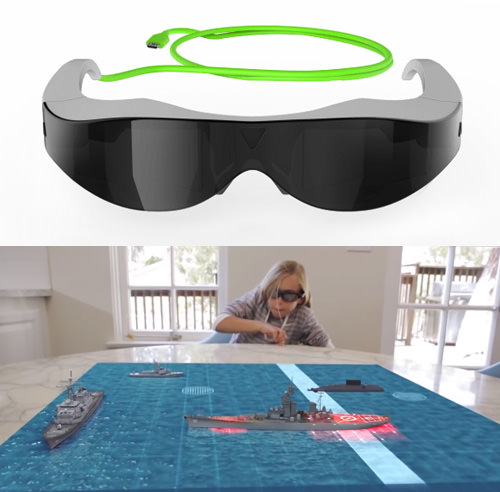

Microsoft first launched HoloLens in 2015 as a gaming-centric consumer product, but so far, very few folks have so much as picked up a Minecraft block with the $3,000 device. Microsoft isn't complaining, though. HoloLens has been a big success with businesses, allowing designers to visualize digital changes on real-life objects and helping employees do complex tasks or high-tech sales demos. In fact, it's been so popular with companies that Microsoft is now expanding sales to 29 new European markets, taking the total up to 39 nations.Microsoft says that companies like Ford and Thyssenkrupp have been asking for HoloLens availability in Spain, Sweden and Turkey, where it's currently unavailable. The device has been particularly popular for so-called firstline workers that repair elevators or build cars, for instance. HoloLens provides such folks with valuable information like repair instructions overlaid directly onto real objects. At the same time, it's hands-free and doesn't disrupt normal vision.
Archive for Maret 2018
10 Hot Augmented Reality Apps To Watch
0

10 Hot Augmented Reality Apps To Watch
Apps to Watch is a bi-weekly series of the most impressive and innovative mobile apps in the business.
Apple’s ARKit was the right boost for the developer's imaginations and with the new iOS update, users are finally able to reap its fruits. As for now, augmented reality is the new buzzword. It opens doors to new immersive experiences and already provides breathtaking solutions for a variety of situations.
Although most of the AR apps still have a way to go, first wave ARKit apps will surprise you with their usefulness and ability to deliver learning and entertainment experiences that have never been experienced before.
Below you’ll find 10 most promising and innovative AR apps powered by ARKit that you can download from the App Store right now.
Dance Reality
Available for free on iOS 11.
Practice makes perfect. If you ever wanted to move with style, Dance Reality is your virtual teacher of Salsa, Bachata or Kuduro steps. It augments virtual footsteps on the floor and provides voice-guidance that helps you to stay on the beat.
Human Anatomy Atlas 2018
Available for $0.99 on iOS 11.
Healthcare professionals, students and enthusiasts will appreciate this powerful app. Human Anatomy Atlas 2018 turns your room into a small anatomy lab by projecting 3D human body models. The app serves as an exceptional reference guide and includes all the structures of body systems. It even visualizes the muscle movements using 3D animations.
Night Sky
Available for free on iOS 11.
Night Sky is a new sky guide that turns your environment into a personal AR planetarium. It identifies stars, planets, constellations and satellites. All you need to do is to point the camera to the sky. Also, it’s full of premium features such as Siri Live sky tours, Solar System exploration or Deep Sky Zoom that allows everyone to travel through the universe.
AirMeasure
Available for free on iOS 11.
AirMeasure is a universal augmented ruler to measure real-world objects. Although the app is primarily designed for entertainment purposes, it proves that augmented reality has the potential to solve real world problems.
GIPHY World
Available for free on iOS 11.
Take your social networking experience to the next level with GIPHY World. Create 3D spaces, record and share videos and scenes for your friends to explore.
IKEA Place
Available for free on iOS 11.
IKEA Place is one of the highlights of the contemporary ARKit apps. It lets you place augmented furniture from IKEA catalogs at your home.
Top Augmented Reality and Virtual Reality games of 2016
0

Top Augmented Reality and Virtual Reality games of 2016
Video games created for Virtual Reality (VR) and Augmented Reality (AR) have made a major leap forward in 2016. Multiple VR headsets have hit the market, along with some mind-blowing titles that are changing the very nature of gaming. As you’ll see below, VR has gotten off to an exciting start, but it’s AR gaming that has already seen its first mega-hit. Here’s our list of the Top 5 Augmented Reality and Virtual Reality games of 2016.
Pokémon Go
It’s official: Pokémon Go has taken the American by storm! Produced as a joint venture between Niantic, The Pokémon Company and Nintendo, Pokémon Go has been nothing less than a cultural phenomena since it’s release in early July. The game has spawned dozens of news stories, seen mobs of people playing it in public, and is so popular the game’s servers keep crashing under the strain. While there is some debate about whether or not Pokémon Go is a true AR experience, the game is close enough to the real thing that it’s being credited with bringing Augmented Reality to the masses for the first time. A number of Marxent employees have been playing, and their enthusiasm only continues to grow. That said, Marxent AR Developer Patrick Rasmussen got an interesting reaction when demoing Pokémon Go for his significant other. “When I showed my wife me walking around my apartment on the map system in Go last night she said that was creepy,” he reports.
House of the Dying Sun
House of the Dying Sun is a tactical space shooter that puts you in the cockpit of “the universe’s most terrifying starfighter” for Virtual Reality space combat. The game will appeal to anyone who saw Star Wars and thought to themselves, “I’d LOVE to fly that X-Wing and blow up the Death Star!” — so everyone, basically. Marxent Marketing Creative Director Joe Johnson has played through House of the Dying Sun, and calls the game “An example of how VR can completely change the gaming landscape, reviving a long dormant game archetype. It’s outstanding.”
Batman Arkham VR
Superhero titles and VR seem like a match made in comic book heaven, and early looks at Batman Arkham VR have fanboys counting the days until they can put on the mask and fight crime as the Caped Crusader. There’s a natural synergy between strapping on a VR headset and donning Batman’s cowl, which will make it easy for players to suspend disbelief and get lost in Virtual Gotham. The teaser trailer has us excited, as does the advance hype on the game, which is calling it “the beginning of the Virtual Reality experiences we need.”Batman Arkham VR is expected to be released in October, along side the heavily anticipated PlaystationVR.
Elite: Dangerous
Though Elite: Dangerous has been floating around since last year (by late last year you could get it to run on the Oculus Rift developer’s kit with minimal hacking), we’re going to consider it a 2016 release since the official Rift version launched in March. The game itself is pretty spectacular, and has really grabbed the attention of Marxent Program Manager Shawn Rothery. “I like it so much I’m building a cockpit with motion simulation for it!” he says. “For the record, Elite looked like this the first time I played it: Keep the ‘You’re so old…’ jokes to yerself. Newbs.”
Vanishing Realms
Vanishing Realms gets my vote. While Vanishing Realms is still in early access, the developer is using an episodic content release schedule, which means the first two chapters are out now (providing 3-4 hours of content) and other chapters will follow in the coming months. Project Engineer Chris Jones has been playing Vanishing Realms, and says “The mechanics and overall feel of the gameplay is fantastic. Sword/shield combat, bow and arrow, or using magic — it all *feels* great. The haptic feedback of the Vive controllers add a lot to the experience of fighting enemies. The game itself feels like a combo of Dungeons & Dragons and The Legend of Zelda, with the art style coming across as very Torchlight-y.” Chris’ final take: “The game looks, performs, and plays great. Plus, you get a decent workout playing through it! While the game progression flows very linearly, there’s honestly a good amount of replay value in just letting other players try it out. It’s a very entertaining title to both play and to watch. It’s easily the most interactive and immersive VR experience I’ve had.”
Honorable Mention: The Foo Show
Marxent front end developer Trace Palmatier went outside the box by highlighting The Foo Show, which is more interesting concept related to VR gaming than a video game itself. It’s basically a talk show in VR, with the first episode featuring the developers of the game Firewatch. They are interviewed about their game while virtually walking around inside it using Vive headsets, picking up 3d models and talking about them. You can also download the episode through Steam and walk around with them. “A lot of the animation and 3D models look pretty goofy right now,” Trace points out, “but they’ve talked about how as their tech improves, they’ll be able to go back and update the visuals of past episodes after the fact. Pretty cool.” Here’s the first episode:
10 Forthcoming Augmented Reality & Smart Glasses You Can Buy
0
10 Forthcoming Augmented Reality & Smart Glasses You Can Buy
Ever since Google launched its Google Glass project, the reality of wearable eyewear seems to be inevitable. Since then, developers from around the world have been trying to take on Google Glass by creating their own wearabledisplay glasses. Instead of just being able take a photo or video, smart glasses have the potential to do so much more. With capabilities such as being able to integrate augmented reality with your own, feeding you live information during your activities, projecting images at a high resolution, and even letting you manipulate 3D objects with ease; it’s only a matter of time before smart glasses become a part of our daily lives.
With that in mind, take a look at our list of 10 forthcoming augmented reality & smart glasses that you can buy to have a look at the future of wearable gadgets. Most of these products are still in development but some are already available for pre-order. Have a look at the future of augmented reality and smart glasses.
1. CastAR
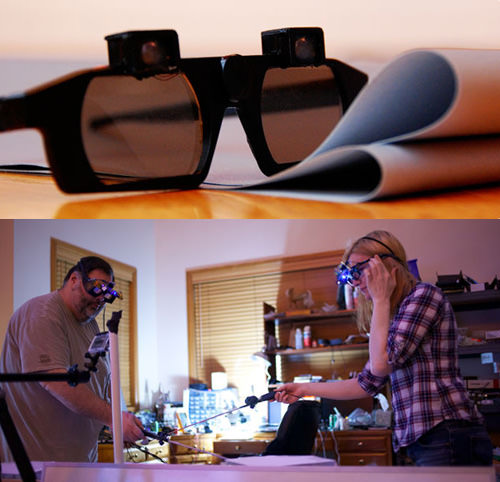
CastAR is comprised of two things, a pair of glasses and a surface for the glasses to scan. There’s a camera in the middle of the glasses that scans your surroundings. It then adjusts accordingly to project images through the two micro-projectors installed on top of the frames. No longer do you need to hold a screen and point it at an AR object. Just wear the glasses and the augmented world is right in front of you. This is a good attempt in bridging the physical and virtual world.
Part of what makes CastAR unique is the additional component called Magic Wand that helps you interact with the augmented world. The Magic Wand can also be used to move an augmented object in the augmented world thus allowing you to do something like play an augmented reality game. [$290-$765]
2. Moverio BT-200
The Moverio BT-200 is an augmented reality headset capable of watching HD contents (3D supported). It also enhances your augmented reality experience when using AR related apps. This headset comes with a front facing camera, a motion sensor, a built-in Dolby Digital Plus for sound, GPS, microphone, compass and projectors. It works by projecting images at a resolution of 960×540 to the transparent glasses, allowing you to watch videos, play games, navigate and plenty more without losing sight of the physical world.
Unlike most augmented reality glasses, instead of being wireless, it needs to be connected to an Android based device at all times. That’s where all the computing power comes from. This allows BT-200 to last for up to 6 hours with impressive specifications like a 1.2GHz dual core processor, 1GB RAM, the drivers for Dolby Digital and an Android system running on Ice Cream Sandwich. [$699]
3. Meta
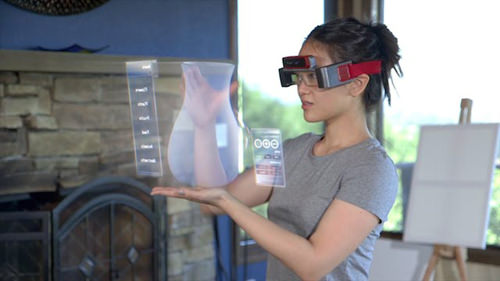
Meta focuses on what Google Glass does not. It overlays augmented reality on top of your reality. Your gestures are identified by Meta to allow you to freely manipulate 3D objects, where you can basically treat it like a clay. Meta also gives you unlimited screens by just grabbing a piece of paper and playing a video onto that paper; turning it into a flexible computer screen of sorts.
It aims to give users the capability of being able to do full-fledged 3D modelling on the go, using nothing other than Meta itself. Its specs include motion tracking, 3D HD display, 3D surround sound, camera and quality lenses. [$667-$3650]
4. Vuzix M-100
This type of smart glasses will help in relaying information directly to youfrom a wearable monocular display, similar to that of Google Glass. Vuzix M-100 also comes with direct-onboard processing features plus a camera to help it capture and display augmented reality. However, its focus is for enterprise, commercial and medical applications.
Vuzix M-100 smart glasses is based on Android, therefore it is compatible with thousands of Android applications. It also includes the Nuance Communication speech-to-text software to help improve the M-100 voice dictation system. [$999]
5. Laster SeeThru
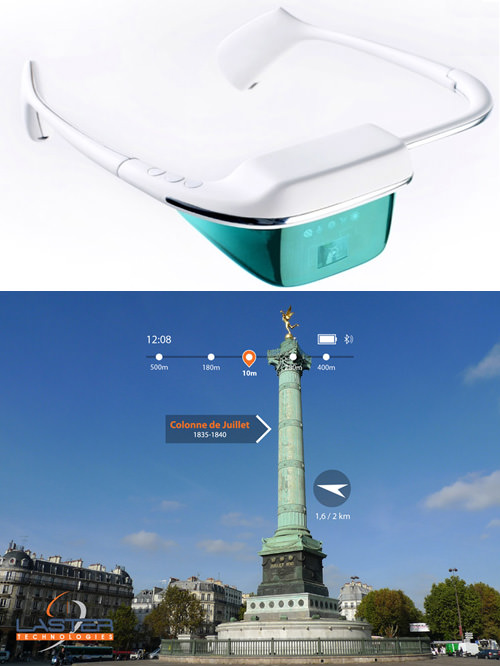
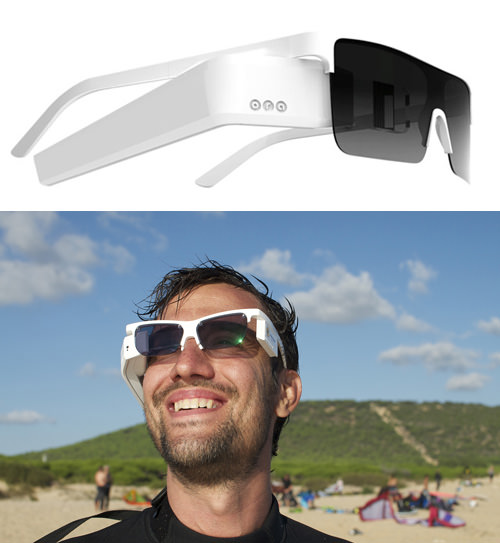
SeeThru claim to be the first genuine wireless augmented reality eyewear and instead of relying on a camera to gather information about your surroundings, it relies only on its own series of location plus a GPS to get things done. The Laster SeeThru is not equipped with a camera to avoid comments regarding invasion of privacy.
The SeeThru focuses almost entirely on sports and activities like biking, parachuting and yachting among other things. It helps navigate and gives live information whenever you’re doing such activities. SeeThru is packed with features like wireless & communication with smartphone, localization and navigation, head tracker, and contacts access from phone just to name a few. [$399]
6. Icis
These augmented reality glasses look like any normal glasses without any visibily big components such as a camera. But that doesn’t mean that Icis doesn’t come with a camera. In fact it does. It even comes embedded with other components such as speaker, microphone, battery, the circuit board and everything to make it look like normal eyewear.
Icis can easily be connected to smartphones running Android, iOS and Windows platform using a bluetooth connection. They’re planning on creating an app called socialFlo that allows you to select which apps you’d want to see present in Icis as widgets. [$220]
7. ORA-S
Optinvent ORA-S is a see through wearable display glasses that enables a variety of augmented applications. They even come with bigger and brighter resolution than that of a Google Glass. ORA-S features two mode when it comes to locating virtual images. The standard AR Mode lets you view images at 0 degree angle and the other is called Glance Mode that enables its user to view from a 20 degree angle. To activate them, all you need is to tilt the wearable display on the right side upwards to activate the standard AR Mode. T ilting it downwards enables the Glance Mode.
This AR glasses comes with specifications such as sound (through audio jack), microphone, orientation sensor, camera, WI-Fi, 1.2GHz dual core ARM Cortex microprocessor, 1GB DDR memory with 4GB Flash memory and its running on Android 4.2.2. Since it can be connected to your smartphone or tablet, ORA-S is a good hands-free wearable computer alternative. [$949]
8. GlassUP
There’s a general idea that most wearable computers with display are basically the second output for your smartphone or tablet devices. GlassUp wants to be just that. Unlike other products in this market niche, GlassUp only projects in monochrome instead of full color to improve its battery life duration. It also projects display into your field of vision making it easier to read your noticiations.
Some of the features that come with GlassUP range from sending out emails to reading RSS feeds. GlassUp can also be used in aiding the hearing impaired and even receive translations display when talking in different languages. It’s more than just a second output for your smartphone. [TBA]
9. Atheer One
Here’s another company that regards its augmented reality glasses as an accessory to your smartphone or tablet devices. The Atheer One smart glasses promotes natural interaction, where you can use hand gestures to control it. It consists of two displays for each eye almost equivalent to a 26-inch tablet being put in landscape right in front of your face.
Atheer One requires your Android device to function as it needs to leverage the 2D available in Google Playstore to be converted into a 3D environment. Because Atheer One displays 3D graphics right in front of your eyes, it’s better to interact with the graphics using your hands, as it feels more natural. [$500-$850]
10. K-Glass
K-Glass is a wearable hands-free display project thats similar to others but has a more unique technology to it. Unlike the others, K-Glass focuses on replicating the process of how our brains form our surroundings when it receives the information from our eyes. Using a technology called Visual Attention Modem (VAM), it categorizes relevant and irrelevant visual data, replicating the human brain’s ability.
This way K-Glass can give its user even more intelligent augmented reality. Hence, providing its user with present and relevant information. For example, you’re looking for something to eat and end up outside of some restaurant, K-Glass can prompt you with an overlay menu of that restaurants food. Therefore, you don’t have to waste time and effort in getting that information. [TBA]
Microsoft HoloLens is now certified protective eyewear
0

Microsoft HoloLens is now certified protective eyewear
On top of the new availability, the HoloLens is now certified for use as basic protective eyewear, with an IP50 rating for dust protection in construction zones, for instance. On top of that, "we're happy to announce a HoloLens hard hat accessory is in production and will be available for purchase next year," Microsoft HoloLens GM Lorraine Bardeen added in the blog post. Intel, for one, demoed a mixed reality headset with a built-in hard hat at CES 2016.
For the consumer market, Microsoft and its partners have launched several Windows Mixed Reality Headsets that are strictly for VR right now, with plans for mixed reality models to come later. However, it's not planning to introduce a new HoloLens model until 2019. When it does arrive, it'll reportedly be equipped with an artificial intelligence (AI) chip that should greatly expand its capabilities.
Microsoft HoloLens UK release date, price and specs
0


Microsoft HoloLens UK release date, price and specs: When will the holographic computer hit the consumer market?

With its formidably futuristic name, the Microsoft HoloLens is billed as the first self-contained, holographic computer – a device which permits you to engage with your digital content and interact with holograms in the 3D world around you. If it sounds too good to be true, that's because it is... unless you're a business or developer, that is.
With its formidably futuristic name, the Microsoft HoloLens is billed as the first self-contained, holographic computer – a device which permits you to engage with your digital content and interact with holograms in the 3D world around you. If it sounds too good to be true, that's because it is... unless you're a business or developer, that is.
The Microsoft Hololens was, however, put to good use recently at the Royal Institute of British Architects (RIBA) Stirling Prize in November, whereupon finalists were able to view holographic, full-scale models of their architecture. The device performed the gratifying task using Trimble's SketchUp Viewer.
Microsoft's HoloLens has now been available in the UK for quite some time with developers beavering away on new projects and businesses slowly starting to adopt the augmented reality headset in experimental workflow tests.
Since its developer-only release, Microsoft has revealed a slew of other AR headsets powered by Windows 10 and built by OEM partners like Acer and Dell. It's still unclear exactly how these devices differ from that of HoloLens – beyond the fact both look like more traditional VR or mixed reality devices than HoloLens' goggle-like appearance.
It's easy to get carried away about HoloLens. Not only is it a seemingly revolutionary device, bringing hologram-like visuals to the real world, it's also a pretty cool concept to work with. However, it's worth remembering that – yes, while Microsoft has demoed some AR game concepts – this is first and foremost an enterprise-level device. Microsoft doesn't see HoloLens coming to the consumer marketplace any time soon and it may never even find its way there at all.
Microsoft HoloLens: UK release date and price
HoloLens Development Edition and Commercial Suite are both currently available to buy in the UK via Microsoft’s website. There is one caveat, however – you need to be a business customer or developer to be able to snap one up. Picking up a Development Edition will set you back a cool £2,719 and for the paltry price of £4,529 you can own HoloLens Commercial Suite. In the US Microsoft is selling HoloLens for $3,000 and $5,000 respectively.
The exact details of Microsoft’s long-term strategy for the HoloLens aren’t clear, but they inevitably include the potential for it to be rolled out as a consumer device. In an interview with BBC Click, Microsoft CEO Satya Nadella confirmed that HoloLens was a “five-year journey”, starting in 2016. Microsoft has teamed up with Acer and Dell to bring cheaper mixed reality headsets to market over the coming year, but neither make use of the HoloLens name and, ultimately, offer up different experiences to Microsoft's in-house headset.
What is Microsoft HoloLens?
Microsoft HoloLens is the first completely wireless, self-contained holographic computer on the market. To put it in simple terms, it projects images over your vision so they appear as holograms, providing you with more information about the world around you or changing the way you perceive a space.
Microsoft’s device is known as an augmented-reality headset, although Microsoft states that HoloLens is a “mixed-reality” device similar to that of IBM’s Project Alloy headset. Unlike virtual reality, which takes over your entire vision and hearing to transport you to another environment, augmented reality complements the world around you.
How does Microsoft HoloLens work?
If you think Microsoft HoloLens sounds like witchcraft, you’re not far from it. Actually, that’s a lie – it’s actually incredibly simple, but it’s taken a long time for the technology to become small and portable enough to be contained within a single unit. Microsoft boasts of its "specialized components" – think sensors, optics, and a custom holographic processing unit – that enable the gadget to "go beyond the screen". A veritable enigma, then...
Basically, within the headset are two see-through holographic lenses that display images projected from HoloLens’ two high-definition “light engines”. Combine this with four “environment understanding cameras”, a depth camera, an “Inertial Measurement Unit” and an ambient light sensor, and you have images that react and respond to the environment around you. These aren’t holograms in the strictest terms but are close enough.
What can Microsoft HoloLens do?
Microsoft is designing HoloLens to be used in the workplace first and foremost. We’ve seen examples of it in 3D design, allowing viewers to experience their creations as scale models or full-size so they can walk around and view them. We’ve also seen it being used in health care to provide patient analysis, or in education to teach people about human anatomy.
Outside of the strong business use cases, we’ve also seen HoloLens demoed at events such as E3, where Microsoft showed how Minecraft could integrate near-seamlessly into multiplayer across PC, Xbox One and HoloLens. You can see it in action in the impressive GIF below.
Microsoft also states that you can use Windows 10 apps effortlessly with HoloLens too, allowing a wide variety of applications to run almost out of the box. One example shown in the past are pinned Skype conversations or video players. One developer even used Microsoft’s Windows 10 Xbox app to stream Halo 5 to a virtual TV screen inside his HoloLens. The future is one where nobody owns a TV anymore.
What’s Microsoft HoloLens like to use?
First and foremost, Microsoft HoloLens is not being sold as a consumer product. This means the experience that we had with it was somewhat limited in terms of its actual potential. Still, from our hands-on time, it was apparent that the biggest issue with HoloLens is its rather limited field of view. Its visor means you can see your surroundings perfectly, but the holographic element is, as Adam Shepherd put it: “like trying to watch a film through a cardboard tube”.
You can read the rest of our HoloLens impressions in our hands-on.
What’s the difference between HoloLens Development Edition and Commercial Suite?
You may have noticed that HoloLens comes in two flavours – Development Edition and Commercial Suite. If you’re wondering what the difference is, and why one is almost twice the price of the other, there’s absolutely nothing setting them apart in terms of the core HoloLens hardware. Instead, the extra cost of the Commercial Suite comes from the addition of enterprise-grade software features to help companies showcase HoloLens’ technology in the workplace. It also comes complete with a snazzy box and snazzy video, totally worth the extra grand and a half.
What powers Microsoft HoloLens?
Microsoft HoloLens is entirely self-contained because inside the headset is a small and powerful computer. Currently, there's no official word on what Microsoft has stuffed in there but, according to PC World, an unnamed source “familiar with the hardware” claimed it was running off a future version of Intel’s Atom processors.
That looks to be backed up by this alleged list of HoloLens specs, posted by Windows Central using diagnostics tool AIDA64:
• OS - Windows 10.0.11802.1033 32-bit
• CPU - Intel Atom x5-Z8100 1.04GHz, Intel Airmont (14nm), 4 Logical Processors, 64-bit
• GPU/HPU - HoloLens Graphics
• GPU Vendor ID - 8086h (Intel)
• Dedicated video memory - 114MB
• Shared system memory - 980MB
• RAM – 2GB
• Storage - 64GB (54.09 GB available)
• App memory usage limit – 900MB
• Battery - 16,500mWh
• Camera photos - 2.4Mp (2048x1152)
• Camera video - 1.1Mp (1408x792)
• Video speed – 30fps
• CPU - Intel Atom x5-Z8100 1.04GHz, Intel Airmont (14nm), 4 Logical Processors, 64-bit
• GPU/HPU - HoloLens Graphics
• GPU Vendor ID - 8086h (Intel)
• Dedicated video memory - 114MB
• Shared system memory - 980MB
• RAM – 2GB
• Storage - 64GB (54.09 GB available)
• App memory usage limit – 900MB
• Battery - 16,500mWh
• Camera photos - 2.4Mp (2048x1152)
• Camera video - 1.1Mp (1408x792)
• Video speed – 30fps
The 'HPU' stands for Holographic Processing Unit, which deals with all the data from the HoloLens' accelerometer, gyroscope, and magnetometer sensors to process gestures and head movements.

